Which Resume Format Should You Use in 2026?
Compare chronological, functional, and combination resume formats to see which one fits your career situation and performs best with ATS software.
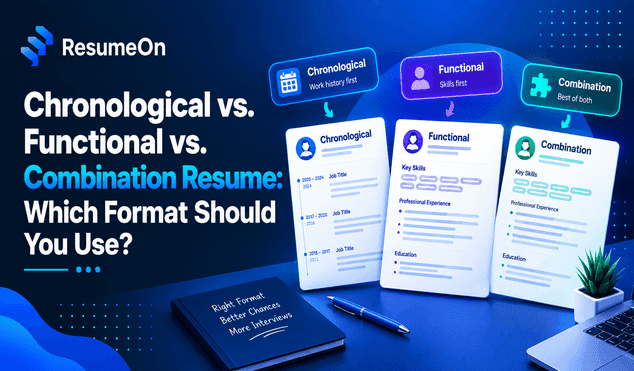
Chronological vs. Functional vs. Combination Resume: Which Format Should You Use?
Picking a resume format feels like a minor decision until you realize it changes how your entire work history gets read. The same career, laid out chronologically versus by skill category, can tell two very different stories to a hiring manager. Most U.S. job seekers default to whichever format they last used without considering whether it actually fits their current situation. This guide breaks down the three main resume formats, when each one works, and when it can quietly work against you and you can build any of the three once you've decided which one fits your career.
The Three Main Resume Formats
The three main resume formats are chronological, functional, and combination, and they differ primarily in how they organize work history relative to skills, each suited to a different career situation rather than one being objectively "better" than the others.
- Chronological organizes experience by job, most recent first, emphasizing career progression over time
- Functional organizes content by skill category rather than by job, de-emphasizing the work history timeline
- Combination (hybrid) leads with a skills summary, then still includes a full chronological work history
Most applicant tracking systems and most U.S. recruiters are more familiar with chronological and combination formats than purely functional ones, which affects how each performs in practice, not just in theory.
The Chronological Resume Format
A chronological resume lists work experience in reverse chronological order, starting with your most recent job, and is the most widely used and most easily parsed format by both ATS software and human reviewers in the U.S. job market.
This format works best when you have a steady, relevant work history without major gaps, and when your career shows clear progression, more responsibility, higher titles, or a logical path toward the role you're applying for now.
Strengths:
- Familiar to recruiters and easiest for ATS software to parse accurately
- Clearly shows career growth and progression over time
- Straightforward to write, since it follows your actual job history
Weaknesses:
- Highlights employment gaps clearly, which can raise questions
- Less effective if you're changing careers into an unrelated field
- Can undersell strong skills if your most recent job isn't your most relevant one
The Functional Resume Format
A functional resume organizes content around skill categories, like "Project Management" or "Client Communication", rather than around individual jobs, with work history reduced to a brief list near the bottom of the document.
This format is sometimes recommended for candidates with significant employment gaps or those changing careers entirely, since it can foreground relevant skills without requiring a strict chronological narrative. In practice, it's also the format most likely to raise a flag with experienced recruiters, who often read a functional resume as an attempt to obscure a gap or a lack of directly relevant experience, and it tends to parse worse in ATS systems that expect a standard experience section.
Strengths:
- Puts skills and qualifications front and center, ahead of job titles
- Can minimize the visual prominence of employment gaps
Weaknesses:
- Viewed with some skepticism by experienced U.S. recruiters
- Often parses poorly in ATS software expecting a standard work history section
- Makes it harder for a reviewer to verify where and when you gained specific experience
Because of these weaknesses, a functional format is generally the format to reach for last, after chronological and combination options have been genuinely ruled out.
The Combination (Hybrid) Resume Format
A combination resume opens with a skills summary or core competencies section, then follows with a full chronological work history, giving you the benefit of leading with relevant skills without hiding your actual job timeline.
This format tends to work well for career changers, since it lets you highlight transferable skills relevant to the new field immediately, while still providing recruiters and ATS software the complete, verifiable work history they expect to see. It's also a strong option for candidates with a mix of relevant and less relevant experience, since the skills summary can direct attention to what matters most before the reader works through the full timeline. If you're moving into an unfamiliar field, running your target job description through ResumeOn's JD Skills Extractor first can help you identify exactly which transferable skills belong in that opening summary.
Strengths:
- Leads with relevant skills while keeping a full, transparent work history
- Performs well with both ATS parsing and human review
- Flexible enough to work for career changers, experienced professionals, and most other situations
Weaknesses:
- Takes more effort to write well, since the skills summary needs to be genuinely relevant, not generic
- Can run long if both sections aren't kept tight
How to Choose the Right Format for Your Situation
You should choose a resume format based on your specific career situation, not personal preference: a steady, relevant work history favors chronological, a career change favors combination, and functional should generally be avoided unless the other two genuinely don't fit.
| Situation | Best Format |
|---|---|
| Steady work history in the same field | Chronological |
| Recent graduate with limited experience | Chronological or Combination |
| Career change into a new field | Combination |
| Significant employment gap | Combination (with a brief, honest note if needed) |
| Freelance or non-linear career path | Combination |
| Returning to work after an extended break | Combination |
Notice that functional doesn't appear as the top recommendation for any common situation. Even in the cases it's traditionally suggested for, career changes and employment gaps, a combination format usually accomplishes the same goal with fewer of the drawbacks.
Does Resume Format Affect ATS Performance?
Yes, resume format directly affects ATS performance, since applicant tracking systems are built to expect a standard structure, and formats that deviate from that structure, particularly functional resumes with minimal work history sections, are more likely to be parsed incorrectly or incompletely.
Chronological and combination formats, when built with clean, single-column layouts and standard section headings, are generally the most reliably parsed across different ATS platforms. This is a separate issue from visual design: even a chronological resume can fail ATS parsing if it uses columns, graphics, or embedded text, so format choice and formatting execution both matter independently. You can confirm which issues, if any, apply to your specific document with an ATS resume checker before you submit it.
Frequently Asked Questions
Is the functional resume format ever the right choice?
Rarely. It can occasionally help candidates with very fragmented work histories highlight relevant skills, but combination formats generally achieve the same goal while parsing better and reading as more credible to experienced recruiters.
Which format is best for a career change?
A combination format is generally best for a career change, since it lets you lead with transferable skills relevant to the new field while still providing a complete, verifiable chronological work history.
Does resume format matter if I'm applying through a company's website versus a job board?
Format matters in both cases, since most company career sites and job boards route applications through some form of ATS. A clean, well-parsed chronological or combination format is the safer choice regardless of where you're applying.
Can I switch formats between different job applications?
Yes, and it's often a reasonable strategy, some roles may call for leading with a skills summary while others suit a straightforward chronological approach, as long as the underlying content stays accurate.
How do I handle an employment gap in a chronological resume?
You can include a brief, honest explanation directly in the resume, or address it more fully in a cover letter, rather than switching to a functional format specifically to obscure it.
Conclusion
The right resume format depends on what story your work history actually needs to tell, steady growth, a career pivot, or a non-linear path, and getting that choice right matters as much as the content within it. ResumeOn's resume builder offers templates built around chronological and combination formats with clean, ATS-friendly structure, so you can focus on the content instead of second-guessing the layout.