Resume Rejected? Fix These Mistakes First
Resume mistakes like ATS formatting errors, vague bullet points, and skipping tailoring quietly cost qualified candidates interviews. Here's how to fix them.
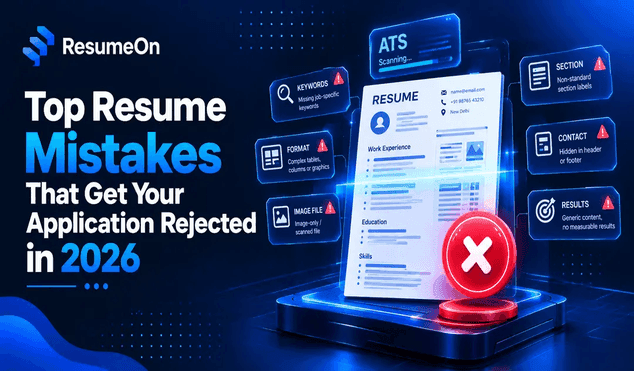
Top Resume Mistakes That Get Your Application Rejected in 2026
Most rejected resumes don't fail because the candidate was unqualified, they fail because of avoidable, mechanical problems: formatting that confuses an applicant tracking system, generic language that doesn't match the job, or simple inconsistencies that make a hiring manager move on to the next file. As more U.S. companies route applications through ATS software before a human ever sees them, these mistakes matter more than they used to. This guide covers the specific errors that most commonly cost candidates an interview, and how to fix each one.
Why Small Resume Mistakes Have a Bigger Impact Than You Think
A resume usually gets a few seconds of human attention on first pass, and often gets filtered by software before that, so mistakes that would be minor in a longer conversation can be disqualifying on a document that's judged this quickly.
The volume of applications most roles receive means reviewers and software alike are looking for reasons to narrow the pool, not reasons to give a borderline resume the benefit of the doubt. That makes formatting and clarity issues functionally equivalent to skills gaps, even when the candidate is actually qualified.
Formatting Mistakes That Break ATS Parsing
Formatting mistakes are one of the most common reasons a qualified resume never reaches a human reviewer, because applicant tracking systems parse resumes as structured text, and certain design choices break that process entirely.
Mistakes to avoid:
- Multi-column layouts — many ATS platforms read left to right across the whole page, scrambling two-column content
- Text inside images or graphics — text embedded in a logo, icon, or design element usually isn't read at all
- Tables for content layout — table cells can be parsed out of order or skipped
- Unusual section headings — "My Journey" instead of "Experience" can fail to map to the fields an ATS expects
- Headers and footers for key content — contact information placed in a header is sometimes missed by parsers
- Non-standard fonts — decorative fonts can render as broken characters when converted to plain text
The safest approach is a single-column layout with standard section headings, a simple font, and no content that depends on visual design to be understood. You can check a specific resume against these issues with an ATS resume checker before submitting it.
Content Mistakes That Weaken a Strong Candidate
Content mistakes weaken an otherwise qualified resume by failing to demonstrate impact, using vague language, or leaving the reader to guess at what you actually accomplished in each role.
Common patterns:
- Listing duties instead of achievements — "Responsible for social media" versus "Grew Instagram engagement by tracking and adjusting posting schedule based on performance data"
- No quantifiable results — numbers, percentages, and scale give a reviewer something concrete to evaluate
- Generic bullet points that could apply to any candidate — bullets should reflect what you specifically did, not a job description template
- Overused buzzwords without evidence — words like "results-driven" or "team player" mean little without a bullet point backing them up
- Inconsistent verb tense — past roles should use past tense, current roles present tense, consistently throughout
Each bullet point should answer a simple question: what did you do, and what happened because of it. If a bullet only answers the first half, it's a duty, not an achievement.
Sending the Same Resume to Every Job
Sending an identical, untailored resume to every job application is one of the most common reasons qualified candidates don't get interviews, because it signals to both ATS software and human reviewers that the resume wasn't built with that specific role in mind.
Tailoring doesn't mean rewriting the resume from scratch for every application. It means adjusting keywords, reordering bullet points to prioritize the most relevant experience, and making sure the skills section reflects the specific language used in the job posting.
A resume that mirrors the vocabulary of the job description, without fabricating experience, consistently performs better against keyword-based ATS scoring. ResumeOn's JD Skills Extractor can pull the key requirements out of a posting directly, so you're matching real priorities instead of guessing at which keywords matter.
Proofreading and Consistency Mistakes
Typos, inconsistent formatting, and small factual errors are disproportionately damaging on a resume because they're one of the few things a reviewer can evaluate with total certainty in a short scan, and they read as a lack of attention to detail regardless of the role.
Watch for:
- Spelling and grammar errors, especially in company names, job titles, and technical terms
- Inconsistent date formats across different entries
- Misaligned bullet points, spacing, or font sizes between sections
- Outdated contact information or a broken LinkedIn link
- File names like "resume_final_v3_use_this_one.pdf" instead of a clean, professional file name
Reading a resume aloud, or having someone else review it, catches far more of these errors than re-reading your own document silently.
Length and Structure Mistakes
Resumes that run too long, bury key information, or use an unclear structure make it harder for a reviewer to find what matters quickly, which works against the candidate even when the underlying content is strong.
For most candidates, one page is appropriate, two pages only make sense with roughly a decade or more of relevant experience. Within that length, the most relevant and recent experience should appear first, and older or less relevant roles can be summarized more briefly rather than given equal weight.
How to Catch These Mistakes Before You Apply
Catching resume mistakes before submitting an application generally requires a combination of ATS-focused formatting checks, a second reader, and a direct comparison against the specific job description you're applying to.
A practical pre-submission checklist:
- Run the resume through an ATS-friendly format check
- Compare it directly against the job description for missing keywords
- Read every bullet point and confirm it shows a result, not just a duty
- Check tense consistency and formatting alignment throughout
- Have someone else proofread it, or read it aloud yourself
- Confirm the file name and format are clean and professional
Starting from a clean, ATS-friendly resume template rules out most of the formatting mistakes above before you've written a single bullet point, which makes the rest of this checklist faster to get through.
Frequently Asked Questions
Can a single typo really get my resume rejected?
A single typo is unlikely to be disqualifying on its own, but multiple errors, or a typo in something critical like a company name or job title, signal carelessness that reviewers often weight heavily given how many other applications they're comparing it against.
Is it a mistake to use a resume template?
No, a clean, ATS-friendly template is not a mistake, the mistake is choosing a heavily designed template with columns, graphics, or embedded text that interferes with parsing.
How do I know if my resume is ATS-friendly?
Check that it uses standard section headings, a single-column layout, no text embedded in images, and simple formatting throughout, or run it through a dedicated ATS checker tool to catch specific issues.
Should my resume match the exact keywords in a job posting?
Yes, where accurate. Mirroring the specific terminology a job posting uses, for skills and qualifications you genuinely have, improves keyword matching without requiring you to fabricate experience.
Is a two-page resume always a mistake?
Not always, but for most early- and mid-career candidates, one page keeps the most relevant information front and center. Two pages become reasonable once you have significant, genuinely relevant experience to include.
Conclusion
Most resume rejections come down to fixable, mechanical issues rather than a genuine skills gap, formatting that breaks ATS parsing, vague content, lack of tailoring, and simple proofreading errors all cost qualified candidates interviews they should be getting.
Once your resume is cleaned up, sign up with ResumeOn to run it through a full ATS check and keep it ready for your next application.