Resume Tailoring: A Fast, Repeatable Process
Learn how to tailor your resume for each job application in 15–30 minutes with a repeatable process, without rewriting it from scratch every time.
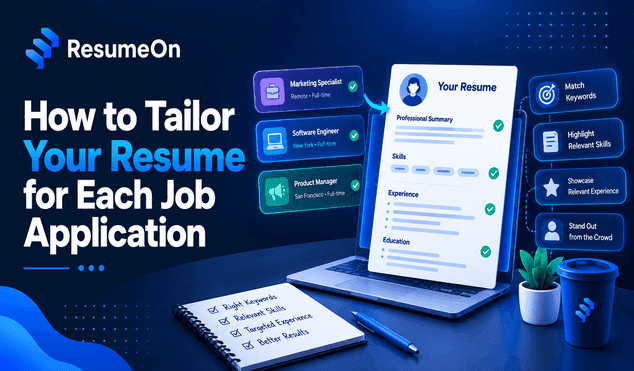
How to Tailor Your Resume for Each Job Application (Without Starting From Scratch)
"Tailor your resume for every job" is advice almost every job seeker has heard and almost none actually follow consistently, mostly because it sounds like it means rewriting the entire document from zero every time you apply. It doesn't. Effective tailoring is a targeted, repeatable process built on top of one strong base resume, not a full rewrite for every posting. Once you've built that base resume, this guide breaks down exactly what to change, what to leave alone, and how to do it quickly enough that you'll actually keep doing it.
Why Tailoring a Resume Actually Matters
Tailoring a resume matters because both applicant tracking systems and human reviewers are evaluating how closely your resume matches a specific role, not how impressive your resume is in the abstract, and a generic resume performs worse on that specific comparison even when the underlying experience is strong.
Most ATS platforms score resumes partly based on keyword overlap with the job description. A resume that never mentions "cross-functional collaboration" specifically, even if you've done exactly that, can score lower against a posting that uses that exact phrase repeatedly. Tailoring closes that gap without requiring you to invent experience you don't have.
What Should You Actually Change Between Applications?
You should change the resume summary, keyword emphasis, bullet point ordering, and skills section between applications, while your actual job history, dates, and core accomplishments stay factually the same across every version.
The parts of a resume worth adjusting for each job:
- Resume summary or headline — rewritten to reflect the specific role and its priorities
- Keyword alignment — matching terminology used in the posting, where it's accurate to do so
- Bullet point order — most relevant achievements moved to the top of each role
- Skills section — reordered or adjusted to prioritize what the posting emphasizes
- Which roles get more detail — older or less relevant jobs can be trimmed to make room for more relevant ones
What generally shouldn't change: your job titles, employment dates, company names, or the core facts of what you accomplished. Tailoring is about emphasis and framing, not fabrication.
How to Read a Job Description for Tailoring Purposes
Reading a job description for tailoring purposes means identifying the specific skills, qualifications, and language the employer repeats or emphasizes, since those repeated terms usually indicate both what the ATS is scoring for and what the hiring manager actually cares about most.
A practical approach:
- Read the job description once fully, without taking notes
- Read it again and highlight every specific skill, tool, or qualification mentioned
- Note which terms appear more than once, those are usually priorities
- Separate "required" qualifications from "preferred" ones, since required items matter more for keyword matching
- Compare that list directly against your existing resume to see what's missing or underemphasized
This takes a few minutes per posting once you're used to it, and it's the step that makes every other part of tailoring possible. If you'd rather automate the comparison, ResumeOn's JD Skills Extractor pulls the key skills and requirements out of a pasted job description directly, so you can see the priority list without doing the highlighting by hand.
Rewriting Your Summary for a Specific Role
Rewriting your resume summary for a specific role means replacing generic language with the specific title, skills, and value proposition that match what that particular posting is asking for, rather than reusing one summary across every application.
A generic summary like "Experienced marketing professional with strong communication skills" could apply to almost any marketing job. A tailored version, "Marketing coordinator with three years of experience running paid social campaigns, seeking to bring campaign analytics and content strategy experience to [Company]'s growth marketing team," directly mirrors what a specific posting is likely asking for, without needing a full rewrite of the rest of the resume.
Matching Keywords Without Keyword Stuffing
Matching keywords without keyword stuffing means naturally incorporating the specific terms a job posting uses into bullet points and the skills section, only where those terms accurately describe your actual experience, rather than repeating keywords artificially or claiming skills you don't have.
If a posting emphasizes "stakeholder management" and your resume currently says "worked with clients and teams," changing that phrasing to match, when it's accurate, is legitimate tailoring. Adding "stakeholder management" as a skill when you've never actually done anything resembling it is not tailoring, it's misrepresentation, and it tends to surface quickly in an interview.
Reordering Content to Lead With Relevance
Reordering resume content to lead with relevance means moving your most applicable experience, skills, and achievements toward the top of each section, so a reviewer sees your strongest match for this specific role first, without needing to read the entire document to find it.
This applies within roles too, not just between them. If a past job involved five different responsibilities, but only two are relevant to the job you're applying for now, those two should appear as the first bullet points under that role, with less relevant duties trimmed or moved lower.
How Much Time Should Tailoring Actually Take?
Tailoring a resume for a specific job typically takes fifteen to thirty minutes once you have a strong base resume and a clear process, not several hours, since most of the work is targeted editing rather than writing new content from scratch.
The first tailored version usually takes longer as you build out variations of your summary and identify which bullet points flex well across different types of roles. After that, most applications follow the same pattern: adjust the summary, check keyword alignment, reorder for relevance, and confirm nothing generic slipped through. Before you submit, running the result through an ATS resume checker confirms your tailored keywords are actually formatted in a way the parsing software can read, not just present on the page.
When Is It Worth Tailoring, and When Can You Skip It?
Tailoring is worth the time for any role you're genuinely interested in and reasonably qualified for, but it's reasonable to send a strong general version of your resume for lower-priority applications where the time investment doesn't match your actual interest in the role.
A useful way to think about it: reserve full tailoring for roles where you'd actually take the job if offered, and use your best general-purpose resume for applications you're submitting more broadly. This keeps your time focused on the applications most likely to matter, rather than treating every submission identically.
Frequently Asked Questions
Do I need a completely different resume for every job?
No. A strong base resume with targeted adjustments to the summary, keywords, and bullet order is enough. The underlying facts, job titles, dates, and core accomplishments should stay consistent across every version.
Is it dishonest to tailor a resume?
No, as long as the changes reflect emphasis and framing rather than fabricated experience. Rewording accurate experience to match a job posting's language is standard practice, not misrepresentation.
How do I know which keywords actually matter in a job posting?
Terms that appear more than once, and anything listed under "required qualifications" rather than "preferred," are generally the strongest signals of what both the ATS and the hiring manager are prioritizing.
Should I tailor my resume even for jobs I'm not that excited about?
It's reasonable to skip full tailoring for lower-priority applications and rely on a strong general resume instead, saving tailoring time for roles you're genuinely interested in.
Can a tool help me compare my resume against a job description?
Yes, a job-match tool can compare your resume text directly against a pasted job description and flag missing keywords or gaps, which speeds up the tailoring process considerably.
Conclusion
Tailoring a resume doesn't require starting over for every application, it requires a repeatable process built on a strong base resume: read the posting closely, adjust your summary and keywords, and reorder content to lead with relevance.
Once your tailored draft is ready, sign up with ResumeOn to keep your base resume, templates, and job-match history all in one place, so the next application takes even less time than this one did.